Spinosaurus mirabilis: A New Saber-Crested Dinosaur Discovered in the Sahara
Authors: Paul C. Sereno, Daniel Vidal, Nathan P. Myhrvold, Evan Johnson-Ransom, María Ciudad Real
Why It Matters
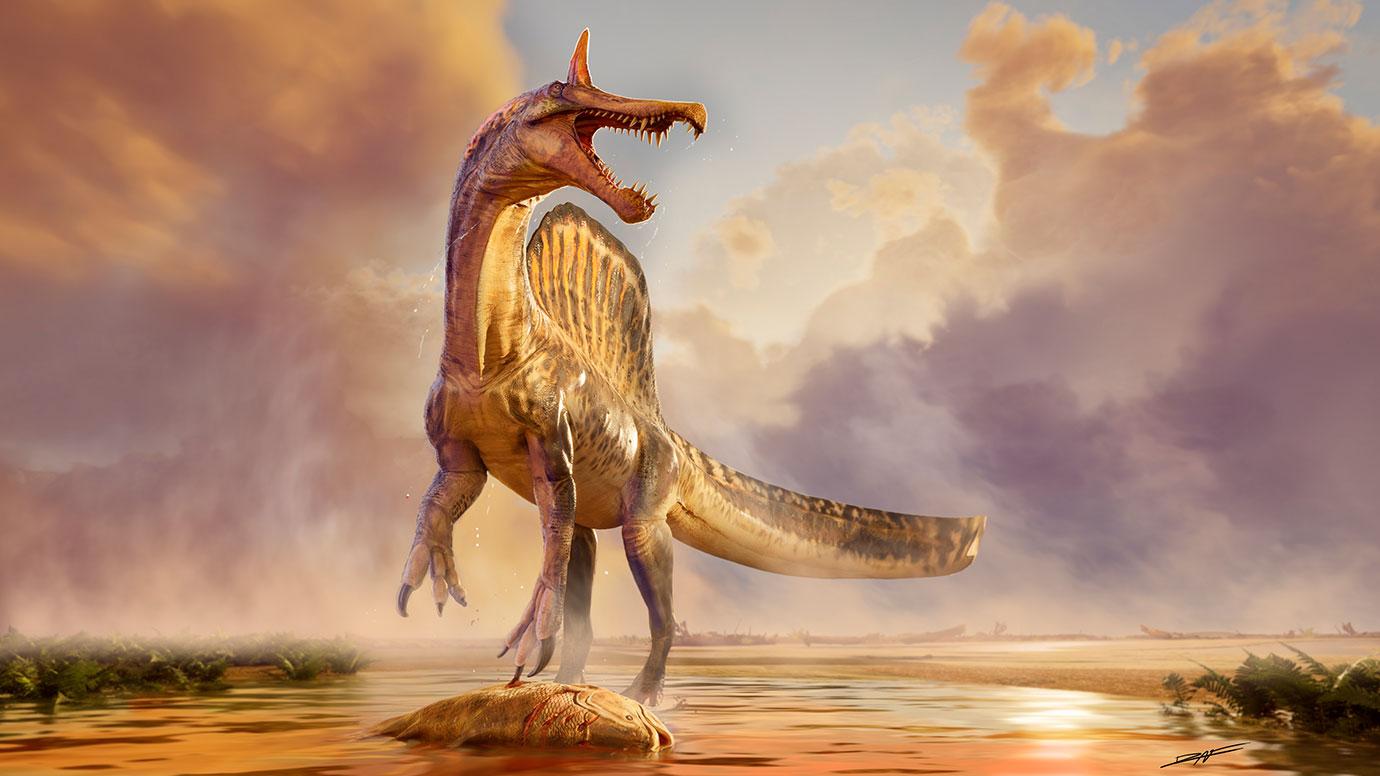
The last time a new species of Spinosaurus was described was over a century ago — in 1915. Now, deep in the heart of the Sahara, paleontologists have unearthed a 42-foot predator sporting an unprecedented ornament: a massive scimitar-shaped crest, sheathed in keratin and likely brightly colored in life.
But the real twist isn’t the size or the crest. Spinosaurus mirabilis lived 400-600 miles from the nearest sea — yet until now, scientists assumed spinosaurids were coastal or even fully aquatic hunters. This discovery upends our understanding of how Earth’s largest predatory dinosaurs actually lived.
The Key Idea
A team of 29 researchers led by Paul Sereno of the University of Chicago has described Spinosaurus mirabilis — a new species of spinosaurid theropod dinosaur. The paper was published on February 19, 2026 in Science and made the journal’s cover.
Spinosaurids — a family of large predatory dinosaurs with elongated snouts, conical teeth, and a distinctive dorsal «sail.» They specialized in catching fish and were among the largest land predators in Earth’s history.
Three key features define the new species:
-
A scimitar-shaped crest. A massive bony projection on the skull, curving like a saber. Covered in keratin and laced with vascular canals — clear signs of vivid coloration in life. Nothing like it has ever been seen in spinosaurids.
-
Interlocking teeth. The upper and lower teeth interdigitate to form a deadly trap for slippery fish — an adaptation known in ichthyosaurs and crocodilians, but unique among dinosaurs.
-
An inland lifestyle. The fossils were found 400-600 miles from the ancient shoreline, in river sediments alongside long-necked dinosaurs — evidence of a forested habitat far from the coast.
The Discovery Story
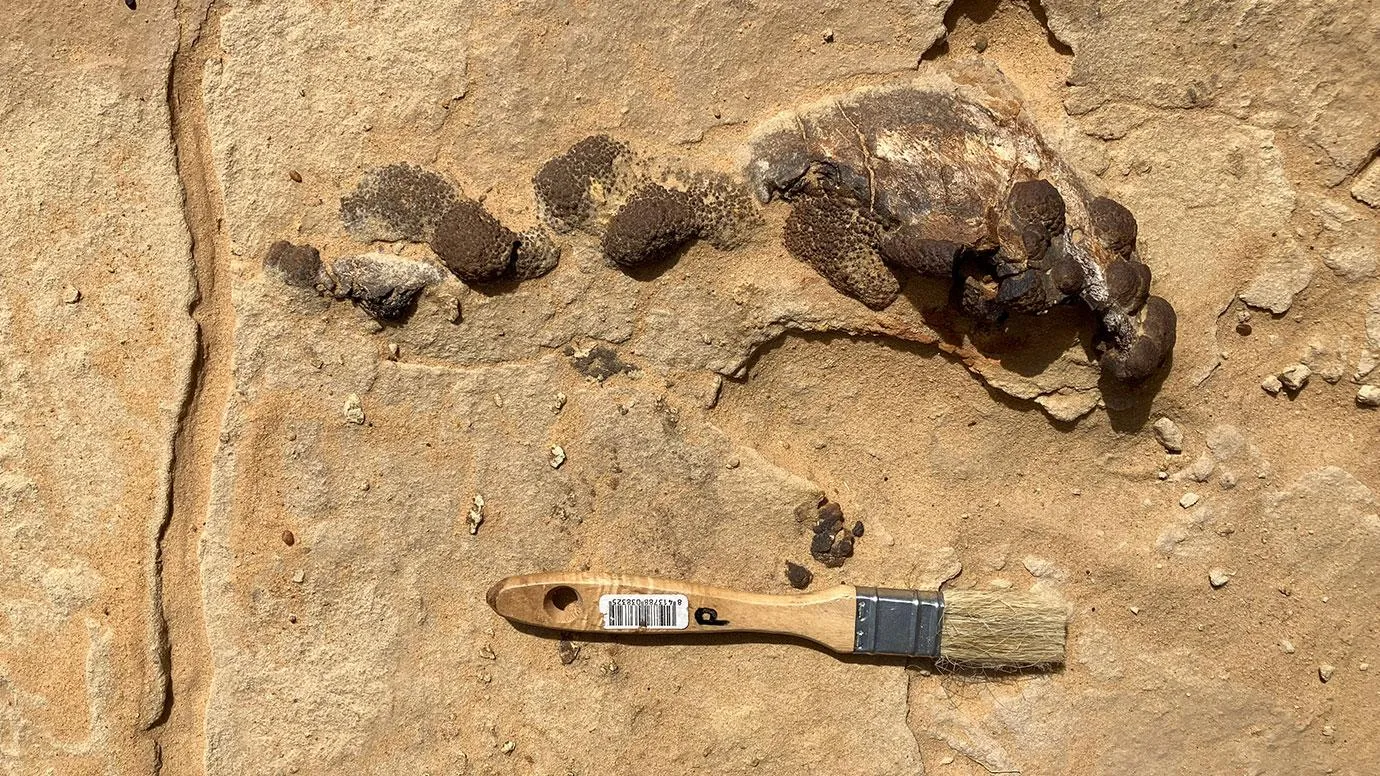
The sweeping crest of the new spinosaurid at the moment of discovery. Photo: Daniel Vidal
It all started with a single sentence in a 1950s monograph by a French geologist who mentioned finding a tooth in Niger resembling Carcharodontosaurus. For 70 years, no one went back to check.
In November 2019, Sereno’s expedition reached the site with the help of a local Tuareg guide who led them on his motorbike deep into the Sahara to fossil bones he’d seen before. There, the team recovered a massive saber-shaped bone and jaw fragments — but didn’t immediately realize what they were holding.
«This find was so sudden and amazing, it was really emotional for our team. I’ll forever cherish the moment in camp when we crowded around a laptop to look at the new species for the first time.» — Paul Sereno
In 2022, a 20-person team returned. They found two more crests and assembled a digital 3D skull model using solar-powered equipment right in the desert. That’s when they knew for certain — this was an entirely new species.
Anatomy and Lifestyle
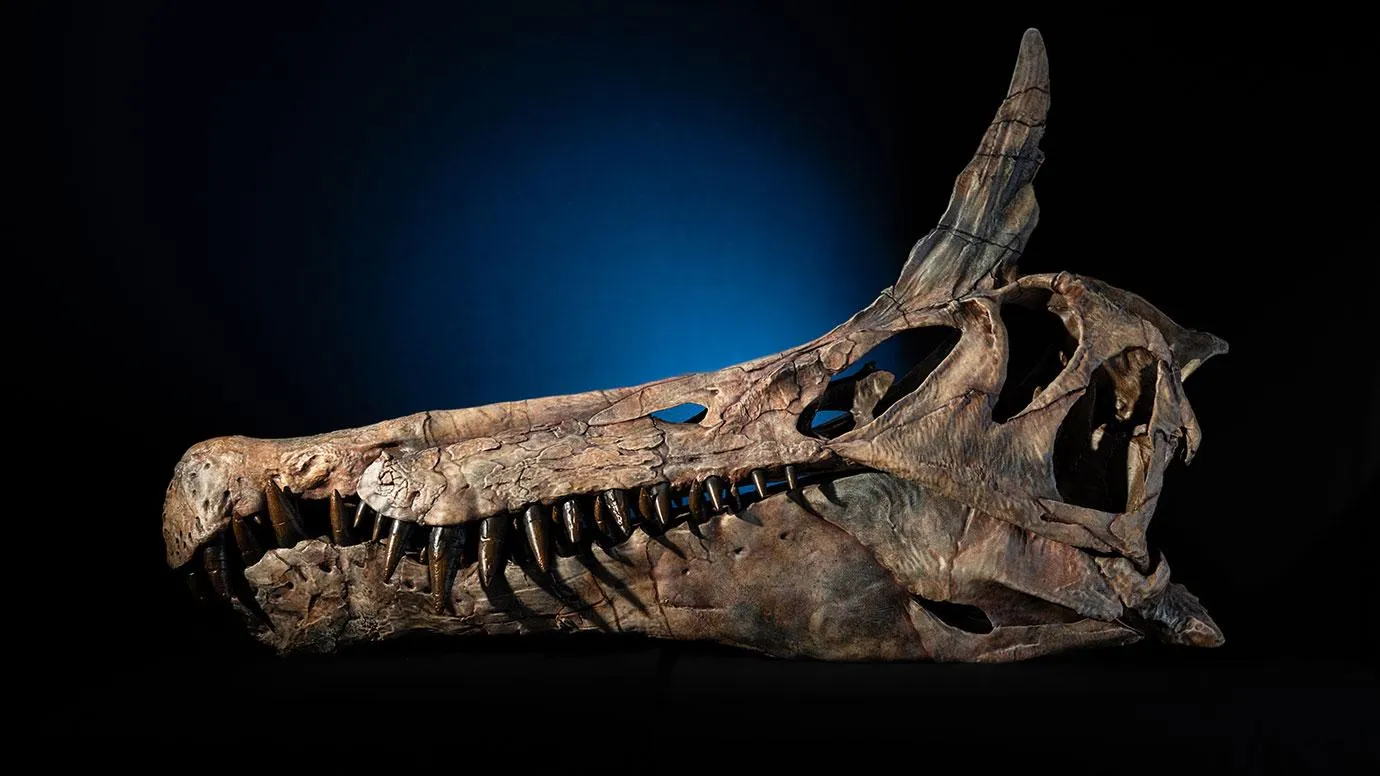
Skull cast of Spinosaurus mirabilis showing the distinctive crest and elongated snout. Photo: Keith Ladzinski
S. mirabilis was a large predator approximately 42 feet long and weighing 6-7 tons — comparable to Tyrannosaurus rex. Its back bore the characteristic spinosaurid «sail» formed by elongated vertebral spines.
«Hell heron» — Sereno’s description of how S. mirabilis lived. Like modern herons, this dinosaur waded through shallows on sturdy legs, ambushing large fish — including coelacanths of the genus Mawsonia.
The biggest mystery is the crest. Why would a 42-foot predator need a flashy head ornament? Scientists believe it served as a visual signal: attracting mates or intimidating rivals. The keratin sheath and branching vascular system suggest intense coloration — possibly red or orange, similar to modern birds with analogous structures.
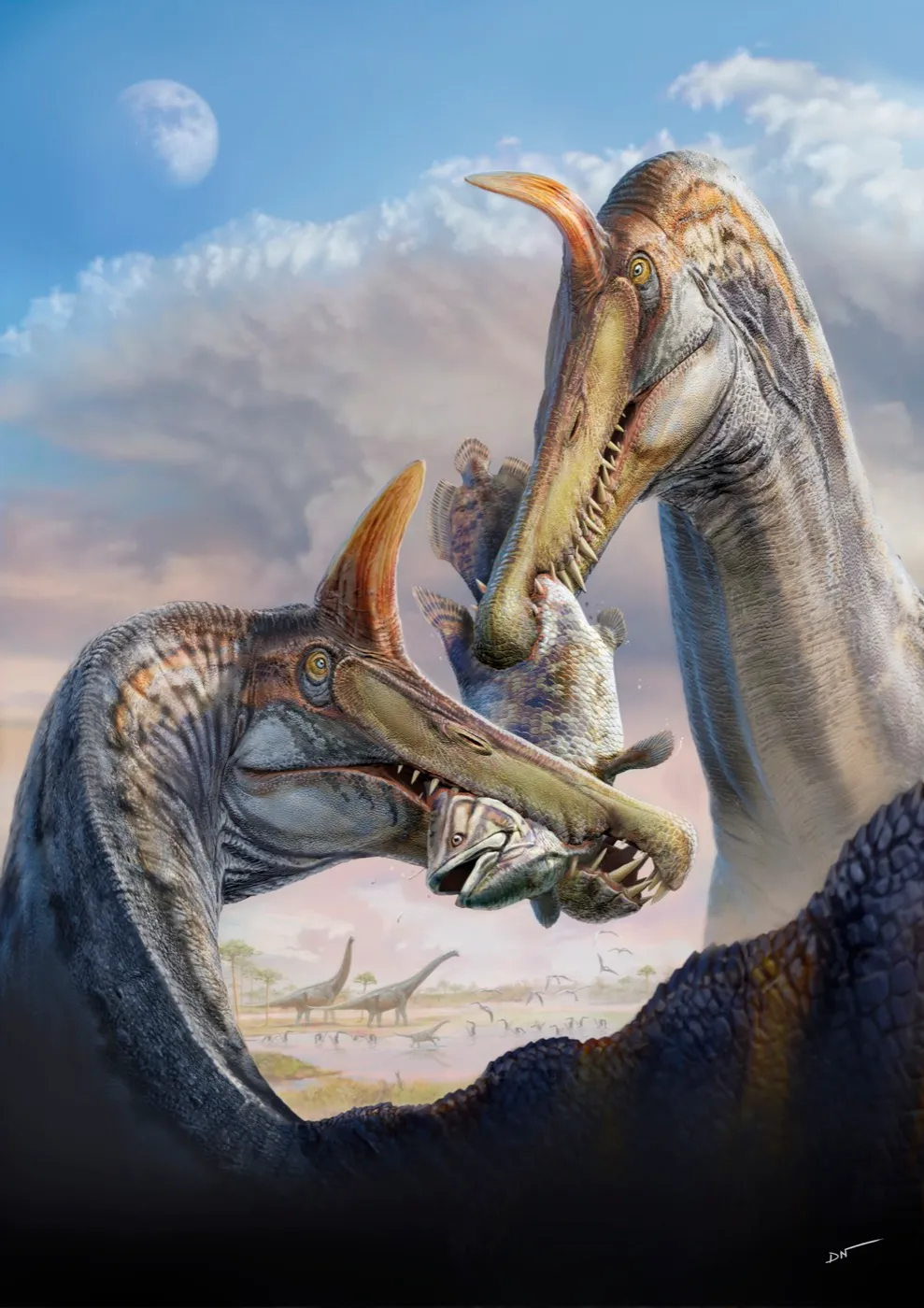
Two male S. mirabilis spar over a coelacanth carcass on a riverbank. 95 million years ago, where the Sahara Desert now stands, there were forests and flowing rivers. Illustration: Dani Navarro
Why This Changes the Picture
Until this discovery, most spinosaurid fossils came from coastal deposits. Some scientists even proposed that spinosaurids were fully aquatic — like giant crocodilians chasing prey underwater.
S. mirabilis breaks that hypothesis. The Farak Formation where the fossils were found lies 400-600 miles from the ancient coastline. Nearby lay skeletons of long-necked sauropods — typical forest dwellers. This was a world of forested rivers, not open sea.
The find fits into a picture of «stepwise radiation» — spinosaurids gradually diversifying over 50 million years. S. mirabilis was one of the last members of this lineage, living just before rising sea levels and climate shifts around 95 million years ago brought their story to an end.
Critical Analysis
Disclaimer: This is an automated analysis based on publicly available data, not an expert review. The paper has been peer-reviewed and published in Science — one of the world’s leading scientific journals.
Strengths:
- Publication in Science with a cover feature — the highest mark of scientific credibility
- Finds from two separate localities (Jenguebi and Iguidi) confirm this isn’t a single anomalous specimen
- Multiple specimens (3 crests, teeth, vertebrae, phalanges) provide a solid morphological basis
- CT scanning and digital 3D skull reconstruction enable detailed anatomical description
Limitations:
- No complete skeleton — the description relies on fragmentary material (crests, jaws, isolated bones)
- Size estimate (42 ft, 6-7 tons) is extrapolated from available fragments
- The vivid crest coloration hypothesis is based on modern animal analogies, not direct evidence
Open Questions:
- Was S. mirabilis territorial? Three crests at one site may point to social behavior
- How exactly did spinosaurids disperse so far inland? What river systems enabled this?
Conclusions
Spinosaurus mirabilis is one of the most significant paleontological discoveries of the decade. A century after the first Spinosaurus was described, we now know these giants were far more diverse than assumed: they lived not only by the sea but also along forested rivers, and adorned their heads with vivid crests — like the hornbills of our modern world.
Starting March 1, 2026, a skull replica and crest model will join the «Dinosaur Expedition» exhibit at the Chicago Children’s Museum. All original fossils are housed in Niger — at Abdou Moumouni University in Niamey, near the future Museum of the River, the world’s first zero-energy museum that Sereno is building on an island in the capital.