52 Kelvin Superconductor: How 2D MXenes Could Transform Physics
Authors: Mohammad Keivanloo, Fateme Dinmohammad, Shashi B. Mishra, Mohammad Sandoghchi, Mohammad Javad Arshia, Mitsuaki Kawamura, Elena R. Margine, Muhammad Haris Mahyuddin, Hannes Raebiger, Reza Pamungkas Putra Sukanli, Kenta Hongo, Ryo Maezono, Mohammad Khazaei
Why It Matters
Superconductivity — a state where electric current flows with zero resistance — remains one of the most sought-after phenomena in physics. The catch: it only occurs at extremely low temperatures. Every kelvin «upward» is a step toward a technological revolution: from powerful MRI magnets to quantum computers.
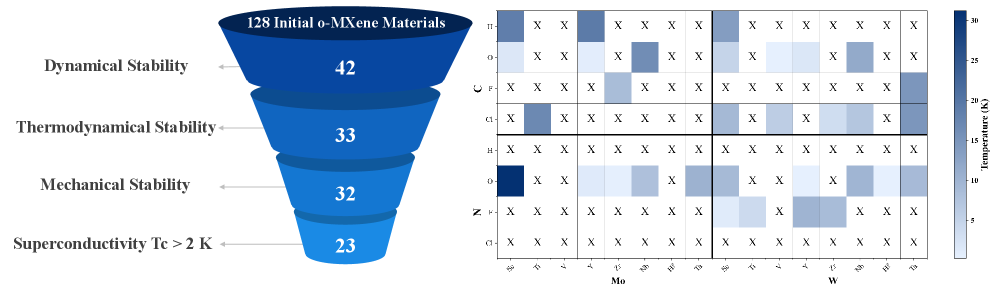
An international team of 13 scientists examined 128 candidates from a new class of two-dimensional materials — MXenes — and found among them a material with a predicted superconducting temperature of 52 K (−221 °C). This is a record for MXenes and a serious claim in the world of 2D superconductors.
The Core Idea
MXenes — two-dimensional materials derived from MAX phases (layered transition metal carbides/nitrides) through chemical etching. Their properties can be finely tuned by changing surface groups — hydrogen, oxygen, fluorine, or chlorine atoms on the surface.
The authors investigated a special subclass — o-MXenes (out-of-plane ordered), where two different metals alternate in a specific order. Formula: M₂M’X₂T₂, where M and M’ are transition metals (Mo, W, Sc, Ti, etc.), X is carbon or nitrogen, and T is a surface group.
The key question: can you find the right combination of metals and surface groups to create a superconductor with a high critical temperature?
How It Works
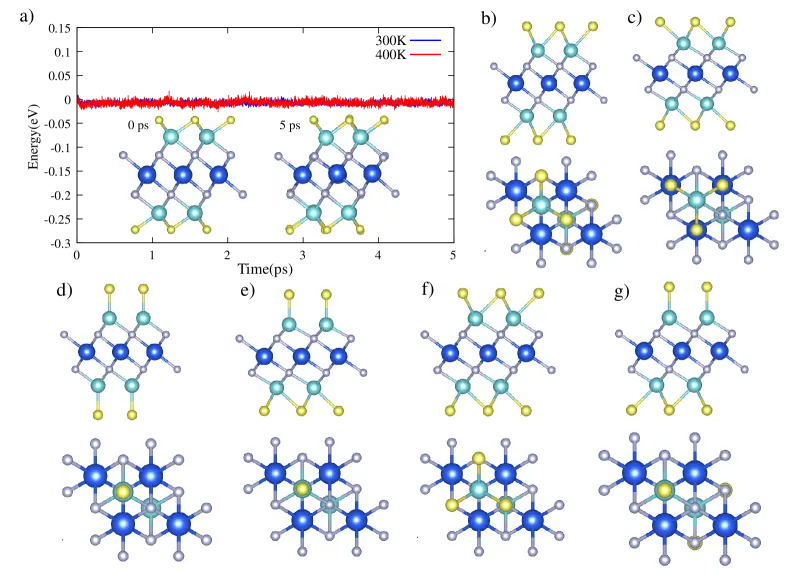
Fig. 1: (a) Stability of Mo₂ScN₂O₂ at 300 K and 400 K in molecular dynamics. (b-g) Six surface functionalization configurations.
The study was conducted «from first principles» — based on quantum mechanics, without fitting to experimental data.
First-principles (ab initio) calculations — computing material properties based solely on fundamental laws of quantum mechanics. No experimental parameters are used — only atomic numbers and positions.
Screening pipeline:
| Stage | Candidates remaining |
|---|---|
| Initial | 128 |
| Dynamically stable | 40 |
| Thermodynamically stable | 33 |
| Mechanically stable | 32 |
Of 128 combinations, only 32 turned out to be fully stable. All nitride compounds with chlorine and hydrogen functionalization were unstable (due to antibonding state occupation).
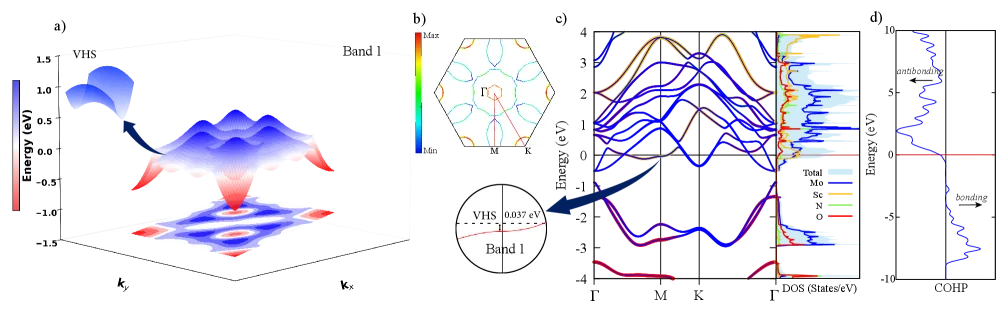
Fig. 2: Electronic structure of champion Mo₂ScN₂O₂: (a) 3D flat band visualization with Van Hove singularity, © orbital-projected band structure.
The champion — Mo₂ScN₂O₂. Why this one? Three mechanisms work together:
-
Flat band — a region in the electronic structure where electrons barely move. This dramatically increases the density of states at the Fermi level — the «fuel» for superconductivity.
-
Van Hove singularity — a mathematical feature (saddle shape) where the density of electronic states diverges. In Mo₂ScN₂O₂, it sits right at the Fermi level — a perfect match.
-
Two-gap structure — the material behaves as a two-gap superconductor (similar to the famous MgB₂), with gaps of ~8.2 and ~10 meV.
Fermi level — the energy boundary below which electronic states are occupied and above which they’re empty. High density of states at this level = more electrons available to form superconducting pairs.
Results
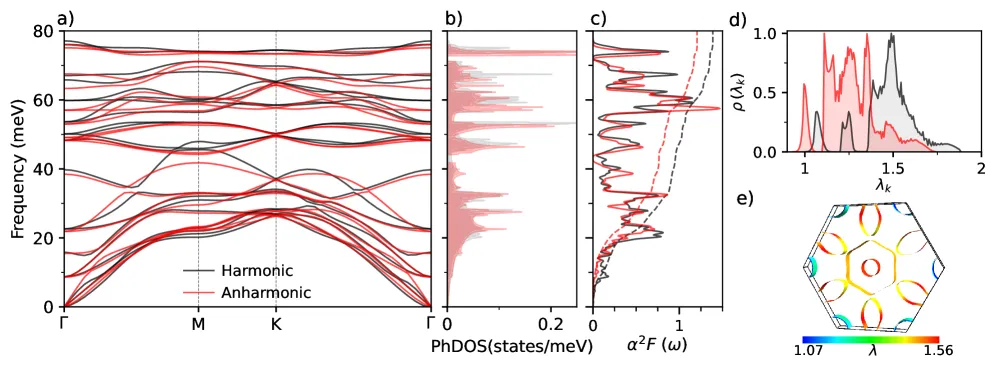
Fig. 3: (a) Phonon dispersion, © Eliashberg spectral function and cumulative electron-phonon coupling constant, (d) λ_k distribution.
The superconducting temperature depends on the calculation method:
| Method | Tc (K) |
|---|---|
| McMillan formula | 38 K |
| Allen-Dynes formula | 38 K |
| Isotropic Eliashberg | 44 K |
| Anisotropic Eliashberg | 52 K |
| With anharmonic corrections | 48 K |
The anisotropic calculation (most accurate) yields 52 K — 8 K higher than the isotropic approximation. Accounting for anharmonic effects reduces Tc by ~4 K, but even with this correction, the temperature remains a record for MXenes.
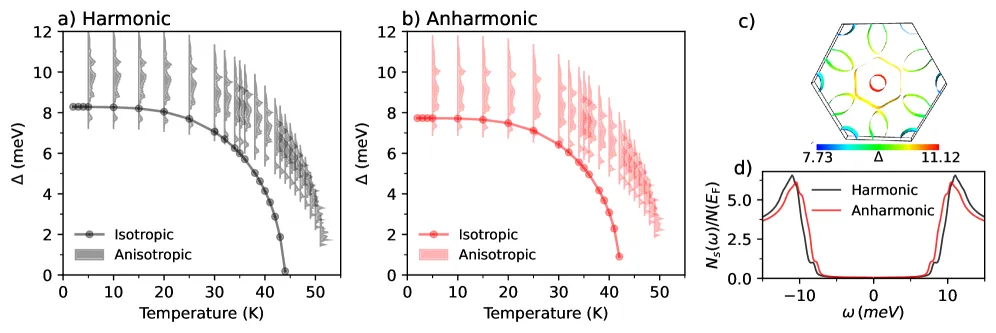
Fig. 4: Temperature dependence of the superconducting gap and quasiparticle density of states at 5 K.
Design principles identified:
- Hydrogen (H) and chlorine (Cl) functionalization of carbides yields the highest Tc
- Oxygen (O) and fluorine (F) functionalization suppresses it
- Nitrides are generally less stable, but Mo₂ScN₂O₂ is the exception
Critical Analysis
Disclaimer: This is an automated analysis based on publicly available data, not an expert peer review. The paper is a preprint and has not undergone formal peer review.
Strengths:
- Large-scale screening of 128 compounds with a systematic approach — not just one material, but an entire map of possibilities
- Six different Tc calculation methods used, including anisotropic Eliashberg equations and anharmonic analysis (SSCHA) — state-of-the-art methods in the field
- Concrete design principles identified (flat band + VHS + surface engineering) applicable to a broader class of materials
Limitations:
- All results are purely theoretical. None of the predicted superconductors have been synthesized or experimentally verified
- Success rate for superconductivity predictions in 2D materials is generally low — estimates suggest only 10-20% of theoretical predictions are confirmed experimentally
- Synthesizing o-MXenes with precise control of metal ordering and surface functionalization remains a significant technological challenge
- 52 K is still extremely cold by practical standards (liquid nitrogen: 77 K)
Open Questions:
- Can Mo₂ScN₂O₂ be synthesized with sufficient crystalline quality?
- How will defects and stacking faults (inevitable in real synthesis) affect superconducting properties?
Conclusions
This work demonstrates that two-dimensional MXenes are not just exotic curiosities, but a platform for designing superconductors with predictable properties. The combination of flat bands, Van Hove singularities, and surface engineering creates a «recipe» for increasing critical temperature.
52 K isn’t room temperature and won’t replace liquid nitrogen. But for a two-dimensional material whose properties can be tuned like a dial on an instrument panel — it’s a serious achievement. If experimentalists confirm even part of these predictions, we’ll gain a new class of superconductors for flexible electronics, quantum devices, and sensors.